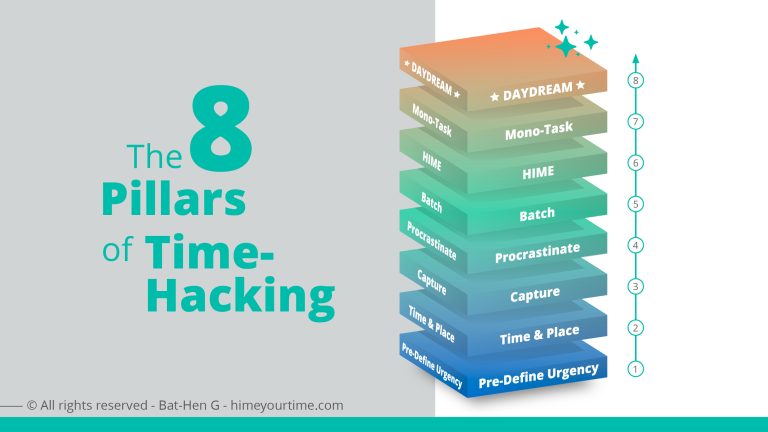
Time-hacking is about designing our attention, energy, tools, and environment so we can produce a large amount of work without ending up with a burnt-out mind or the feeling that getting out of bed is a struggle. Today’s struggles evolve around the flood of information, new tools, agents, skills all leading us into mental fragmentation and fatigue.
However, a human-centric approach to productivity solves these issues. It consists of eight gradual, progressive pillars, each one building on the one before it, helping knowledge workers stay ahead of their task list while still having time and energy for leisure, friends, and books.
1. Create a Buffer by Pre-Defining Urgency
You cannot get better outcomes from your day without addressing this first step. I often see people prioritizing their inbox by sender name, reacting to Slack only if the message comes from their manager, or handling tasks based on internal politics instead of professional reasoning. Those are not habits that improve results. To become truly effective, you need a buffer: a structure that lets you decide what to work on and when, unless something is genuinely urgent. And truly urgent situations should make up no more than 20 percent of tasks, in a classic Pareto fashion.
At workshop sessions, we spend at least an hour helping a team decide what is urgent and what should happen when something urgent does occur. That is how a real buffer is created, and that buffer is what makes productivity sustainable.
The goal is not to become constantly available; the goal is to become consistently effective. In fact, availability is often the opposite of productivity.
For more on this topic read my article “ How to Create a Buffer and Have a Life “
2. “This isn’t the time, nor the place”
This is one of my Nana’s best lines: some words and behaviors simply do not belong at every table or in every situation. Before responding immediately, pause. In most cases, the right move is not an instant answer, but a better time and a better place.
What this may sound like: This isn’t a good time now to discuss this topic. Please email me and I’ll get back to you next week” Or: “Text me and I’ll bring it up at tomorrow’s daily.” Or: “Call me next week when I’m in that meeting, so we can discuss it with the right team at the right time.”
A task that is postponed strategically is not a failure; it is a smarter move toward enhanced productivity. Saying “yes, but later” protects focus without destroying momentum.
For more on this topic, read my article : “… A Time for Every Purpose Under Heaven…” King’s Solomon’s Wisdom in The Service of Productivity “
3. Capture Immediately
Our minds are made for advanced thought patterns, not for storing data (David Allen, GTD). That is why I recommend creating a structured funnel of maximum 2 tools, through which all tasks, notes, ideas, and media pieces are captured immediately and moved out of our heads. The moment we try to remember something instead of capturing it, we block the brain’s ability to think deeply.
My rule of thumb is: up to 2 capturing tools only, one analog and one digital, for all personal and professional matters, 2 click max. Widgets are faster than apps or messaging tools. Capture fast, sort and execute later. The swiftness of the act is key for enhanced productivity.
For more on this topic, read my articles:
How to Quickly Email Yourself a Note

4. Procrastinate on Purpose
Procrastination has a bad reputation both because people confuse delay with avoidance and often lack an easy-to-maintain method for which to manage their deferred tasks.
But deliberate delay can actually improve the quality of your work. It gives you more precision, more focus, and better timing. Most of the time, we do not need to act immediately; we need more information, more context, a better tool, or a clearer mind before we can act well. Procrastination is not weakness. It is a discipline that preserves energy for the improved moment in which the action can unfold smoothly into execution.
For more on this topic, read my article :
WRONG, WRONG, WRONG: 3 Myths About Work that are No Longer True
5. Batch
Batching is the natural next step before HIME takes full effect (See #5).
A scattered day leaks energy at every transition. Batching solves that by grouping similar tasks together: calls in one block, computer work in another, meetings on one day, deep work on another. Taking the time to batch tasks preserves flow and reduces the cost of switching. When we protect our internal batteries, we have enough energy left for the second and third parts of the day: children, spouse, leisure, sport, friends, all of which require a great deal of our energy.
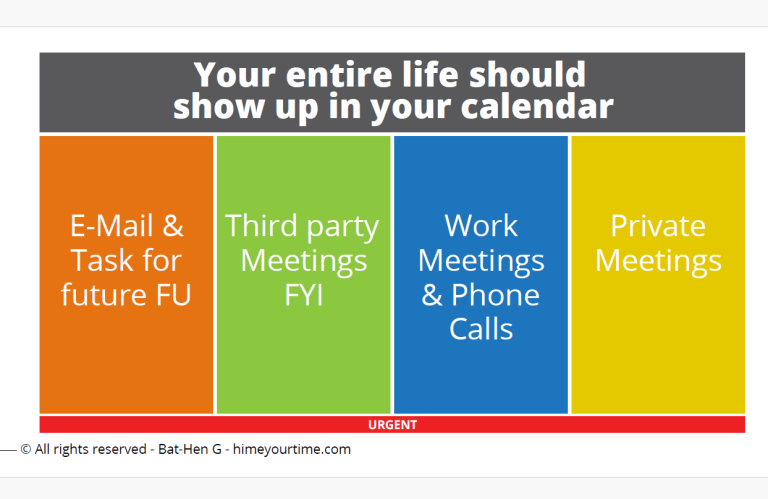
The same logic applies to the calendar. One central calendar, color-coded by my five categories (see pic below), makes life visible and manageable. When tasks, meetings, and commitments are sorted into their right time and place, the week stops feeling like a pile of obligations and becomes a real manageable , even enjoyable, work method.
For more on this topic, read my article: Being Efficient & Effective is Not the Same Thing
6. HIME = High Impact, Minimal Effort
You know how sometimes you work for three hours but produced the outcomes of an eight hour work day? And how sometimes you work eight hours and still feel like the whole day gone wasted? That difference usually comes down to energy alignment, which is key for enhancing productivity. HIME is your scheduling system. Once you reach a point where about 80 percent of your work day is aligned with your HIME, your deliverables skyrocket. That is Pareto in action again.
Avoid saying “I’m a morning person” or “I work better at night.” Instead, say something more precise: “I’m great for X during the morning, fabulous for Y around noon, and exceptional for Z after lunch.” That is more useful and easier to apply in real life.
Once you understand your energy levels and communication preferences, the next step is to align them with your team.
For more about this topic, read my pate : About HIME
7. Mono-Task & Mindfulness
Mindfulness = being 100% present at any given moment
Mono-task = giving your full attention to the medium at hand.
Attending a meeting? Look people in the eye, avoid all digital devices.
If a half-hour meeting suddenly becomes a ten-minute meeting because all devices stayed outside the meeting room, that is not a small detail. That is reclaimed life.
Taking a call? Stand up and walk.
Deep work? Set up white noise in the background.
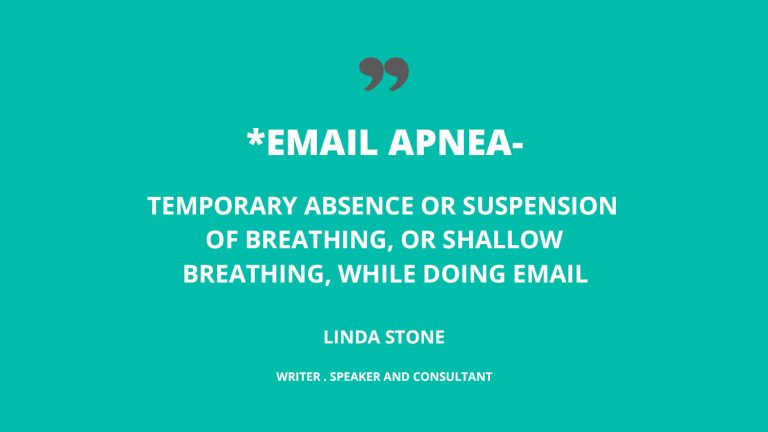
Sorting your inbox? Breathe deeply and give it your full attention to avoid Email Apnea (see Pic below) .
For more on this topic, read my article: 3 Sounds You Might Want To Try
8. Daydream 3 times a day, 5-10 min each
As discovered in brain research, the creative part of the mind thrives under the lack of stimulation. It needs quiet, distance, and a little emptiness . That is why passive gaze time matters so much: looking out a window, taking long showers, sitting with a blank wall and letting the mind wander can unlock massive amount of insight, breakthroughs, ideas, imagination and problem solving abilities. This is not meditation in the formal sense, and it is not another productivity hack disguised as relaxation. It is a deliberate reset for the system that thinks, synthesizes, and connects ideas . A few short pauses a day can improve the quality of every hour that follows.
For more on this topic, read my article: Wish To Increase Employees’ Productivity? Indulge Them to Daydream At Least Three Times Per Day
Time-hacking is not just a productivity method. It is a way of living, Once you internalize that not everything needs to happen now, not every request deserves an immediate answer, and not every task deserves the same kind of attention, you create a new kind of space. That space makes room for better decisions, stronger creativity, and calmer execution.